
Environmental Review
Amended Record of Decision
An Amended Record of Decision has been issued by the Federal Highway Administration (FHWA) and Federal Transit Administration (FTA). This significant milestone allows the IBR Program to begin construction-related activities.
View the Amended Record of Decision
- Amended Record of Decision
- Appendix A: CRC Record of Decision
- Appendix B: Maps of Amended Selected Alternative
- Appendix C: Summary of Reasonably Foreseeable Effects
- Appendix D: Mitigation Commitments
- Appendix E: Permits and Approvals
- Appendix F: Executed Section 106 Programmatic Agreement
- Appendix G: Comments on the Final SEIS and Responses
- Appendix H: Final SEIS Errata
- Appendix I: References
What is the Amended Record of Decision and what comes next?
An Amended Record of Decision was issued July 1, 2026, by the Federal Highway Administration and Federal Transit Administration. The Amended ROD completes the federal National Environmental Policy Act (NEPA) review process, clearing the way for Washington and Oregon to begin identifying a contractor and securing permits to replace the Interstate 5 (I-5) Bridge over the Columbia River.
This milestone reflects decades of planning and coordination between Oregon and Washington to replace the I-5 Bridge. The investments and design options that advanced through the NEPA process reflect years of public and technical input. The Program coordinated closely with partner agencies, consulted with federally recognized tribes, and engaged with elected officials, advisory groups and communities across the region — including residents, commuters, transit users, the freight and maritime industries, and community organizations.
The NEPA process included the evaluation of multiple design options for several of the transportation investments considered. The Program’s design option recommendations are documented in the Final SEIS. The Amended ROD selected the design options approved for construction, including:
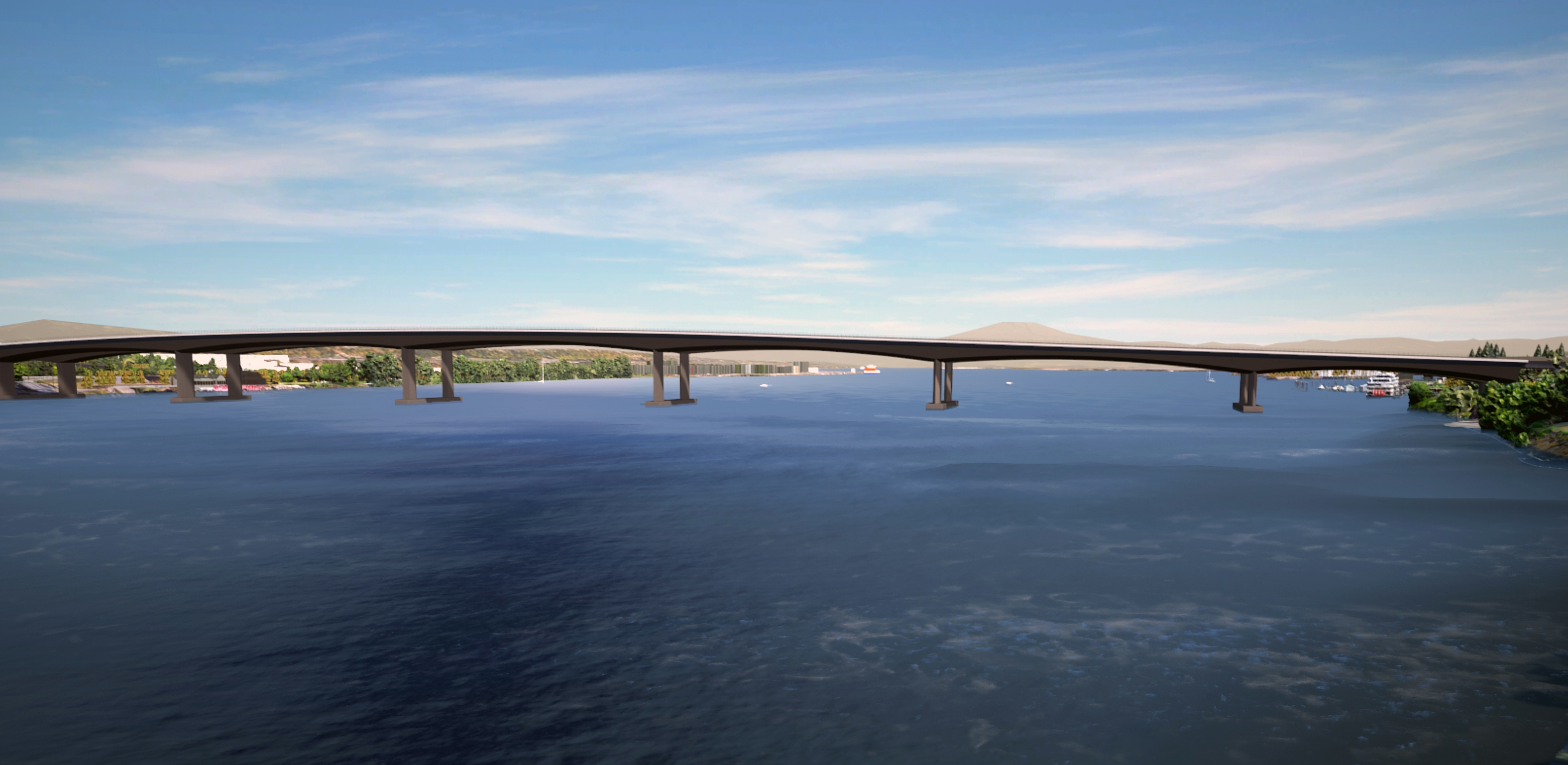
- A single-level fixed-span bridge configuration across the Columbia River
- One auxiliary lane in each direction to improve safety by giving cars room to enter and exit
- Inclusion of C Street ramps to connect downtown Vancouver to I-5
- Maintaining a centered I-5 alignment through Vancouver
- Dispersing 1,270 parking spaces across multiple park-and-ride sites
With $5.7 billion in available funding, the Program is advancing the first funded phase of construction and moving key improvements within reach: a modern, earthquake-ready crossing providing better connections to the regional transportation system for people and businesses on both sides of the river.
Final SEIS documents impacts and recommends design options
The Final SEIS documents the extensive analysis of the reasonably foreseeable effects of the proposed transportation investments outlined within the Program’s Modified Locally Preferred Alternative. It also makes recommendations on five design options studied during the environmental review process, responds to more than 9,100 individual comments the Program received during its public comment period in the fall of 2024, and outlines commitments the Program is making to avoid, minimize and mitigate impacts to the environment and community.
What is an Environmental Impact Statement?
This comprehensive document is a federal requirement under the National Environmental Policy Act (NEPA). The SEIS supplements the findings of previous planning work and analyzes the potential impacts and benefits of the Modified LPA compared to a No-Build Alternative.
The SEIS supplements the Columbia River Crossing (CRC) Final Environmental Impact Statement.
Publishing the Draft SEIS in September 2024 kicked off a 60-day public comment period. Input received from the community during the public comment period helped shape the solution advanced to the Final SEIS as the Program works to replace the aging Interstate Bridge with a safer, more resilient multimodal corridor that is responsive to the needs of travelers and communities within our region for decades to come.
What can be found in the Final SEIS?
- Updated analysis of the potential impacts and benefits of constructing the proposed Modified LPA.
- The IBR Program’s recommended design options.
- IBR Program’s commitments to avoid, minimize and mitigate effects to the environment and community.
- Responses to approximately 3,600 public comment submissions containing more than 9,100 individual comments.
- Final Draft Programmatic Agreement (PA) for Section 106 of the National Historic Preservation Act.
Design updates
In addition to recommended design options, the IBR Program made a few changes to the design of proposed investments since the Draft SEIS.
These changes were influenced by a variety of factors such as public feedback, design progression, and avoidance of certain impacts and include:
- Addition of a shared-use path along Victory Boulevard between Expo Road to N Whitaker Road.
- Location of the Expo Center overnight facility moved to the west side of the Expo Center campus near N Force Avenue.
- Slight reduction in the scale of the Marine Drive interchange design to avoid some impacts to the dog park at East Delta Park.
- Modifications to the alignment of Center Avenue to accommodate construction sequencing.
- Added an Active Transportation connection between Tomahawk Island Drive and Jantzen Ave.
- Inclusion of an active transportation path along the east side of I-5 between McLoughlin Boulevard and Fourth Plain Boulevard.
- No longer pursuing replacement of the existing overpass at Fourth Plain Boulevard as it is not affected by the freeway modification beneath it or interchange ramp changes.
Avoidance, minimization and mitigation
The Final SEIS includes the Program’s commitments to avoid, minimize, and mitigate adverse community and environmental effects that would occur resulting from construction of the proposed Modified LPA. These measures will be adjusted as needed for differences in effects associated with the design options. The IBR Program will comply with all environmental laws and obtain necessary permits that outline protections for air quality, water quality, fish and wildlife, and community livability (e.g., noise levels, light and glare, dust, etc.) during construction.
For a full list of proposed avoidance, minimization and mitigation measures, see Table 5 of the Final SEIS Summary or Appendix M.
Recommended Design Options
Auxiliary Lanes Design Options
- Recommended: One auxiliary lane in each direction on the new Columbia River bridges and nearby sections of I-5
- Two auxiliary lanes in each direction of I-5 would extend across the new Columbia River bridges in addition to and in combination with existing auxiliary lanes from approximately Interstate Avenue/Victory Boulevard to SR 500/39th Street
The one and two auxiliary lane design options would provide important benefits to traffic operations, including congestion, travel time and traffic safety.
The one auxiliary lane design option is recommended because it would align more closely with local planning goals and policies, would have a smaller footprint and would cost less over the life of the project.
Bridge Configuration Design Options
- Recommended: Single-level fixed-span bridge configuration
- Double-deck fixed-span bridge configuration
- Single-level movable-span bridge configuration
On Jan. 16, 2026, the U.S. Coast Guard provided a Preliminary Navigation Clearance Determination (PNCD) of greater than or equal to 116 feet based on the revised IBR Navigation Impact Report, the drawbridge logs for the existing bridge, and public comments. The PNCD allows for a fixed-span bridge option.
All bridge configurations would provide important benefits to highway operations and safety and have similar impacts to many resources.
The main differences between the two fixed-span configurations and the movable-span configuration is that the movable span would provide more vertical clearance to accommodate larger vessels and a lower grade for all land-based transportation modes (which would benefit freight and active transportation users in particular), but would periodically disrupt all other land-based transportation modes (personal vehicles, freight, transit, and active transportation) due to bridge openings.
The main differences between the double-deck and single-level fixed-span configurations are that the slightly higher grade of the double deck would impact freight traffic and active transportation users, and the single level would have faster emergency response times (although there would also be more exposure to vehicles) and give users of the shared-use path a greater sense of security due to “eyes on the path.” The fixed-span configurations received generally positive comments from the public, while there was mixed feedback on the movable-span due to the tradeoffs identified above.
C Street Ramps Design Options
- Recommended: With C Street ramps
- Without C Street ramps
Both C Street ramp design options would provide important benefits to highway operations and safety and have similar impacts to many other resources, particularly the natural environment.
While there would be some short-term construction cost savings and reduced visual impacts without C Street ramps, there would be greater impacts to local traffic as traffic that would have used the C Street ramps would be routed to the Mill Plain interchange, thereby increasing traffic volumes on the local street network and requiring additional mitigation.
Both design options received a mix of positive and negative feedback from the public, however there were more comments in support of the With C Street Ramps design option. The With C Street Ramps design option also has more support among local partner agencies.
I-5 Alignment Design Options
- Recommended: Centered I-5 alignment
- I-5 westward shift
Both I-5 mainline alignments would provide important benefits to highway operations and safety and have similar impacts to many other resources, particularly the natural environment.
The I-5 Westward Shift design option would notably increase acquisitions resulting in the displacement of an additional three businesses (with approximately 140 employees) and 33 residential units, and the physical removal of the historic Normandy Apartments. However, the I-5 Westward Shift would reduce the area of acquisition and other impacts to the Vancouver National Historic Reserve Historic District (which includes the Fort Vancouver National Historic Site).
While some public comments noted the reduced impacts to the VNHR Historic District from the westward shift design option, others raised concerns about its effects on safety, congestion, and increased residential and business displacements.
Park and Rides Design Options
- Recommended: Provide parking capacity to accommodate 1,270 vehicles dispersed among up to five park and rides.
- Provide parking capacity to accommodate 1,270 vehicles distributed across just two park and rides: one park and ride with 570 parking spaces near the Waterfront Station and one park and ride with 700 parking spaces near the Evergreen Station. The locations for park and rides that were evaluated included:
- Potential Waterfront Station park and rides: Columbia Way (below I-5), Columbia Street/SR 14, Columbia Street/Phil Arnold Way
- Potential Evergreen Station park and rides: Library Square, Columbia Credit Union
All of the park and rides would provide similar benefits to the community by increasing the area from which the transit stations draw passengers and making transit more accessible. There could be minor localized differences in traffic patterns and transit ridership depending on the location of spaces. Dispersing the 1,270 parking spaces across up to five park and rides rather than concentrating the spaces at a single location near the Waterfront Station and Evergreen Station would promote compatibility with local planning goals and plans for multiuse development, multimodal access, and attractive public spaces.
As the Program progresses, the IBR Program team will refine the Program’s transit components, which will contribute to further information on parking needs to support transit ridership. Park and rides would be designed to promote station access, support City of Vancouver objectives to increase downtown mobility, and would include existing parking facilities in downtown Vancouver to help meet the projected demand in areas where City of Vancouver studies show surplus parking supply.
What We Heard: Draft SEIS Public Comments
Over the course of the 60-day Draft SEIS public comment period in the fall of 2024, thousands of community members shared their thoughts on the benefits and effects of the Modified LPA. The Program received more than 3,600 public comment submissions that included over 9,000 individual comments.
What is the difference between a submission and a comment?
A submission refers to the entire document submitted, such as an email, letter, or comment form. Each submission is reviewed and separated into individual comments based on each topic. A single submission can contain multiple comments.
View Public Comment Submissions
FHWA and FTA, in coordination with WSDOT and ODOT, prepared standard responses and individual responses to comments received during the public comment period for the Draft SEIS. Standard responses address subject areas for which multiple comments were received. Individual responses address all other comments on issues that fall outside the standard responses. Individual responses are intended to complement information provided in the standard responses by responding directly to specific topics or questions in the comment that are not addressed by the standard responses. This Final SEIS incorporates revisions made to the Draft SEIS based on these standard and individual responses.
Comments received on the Draft SEIS are in Appendix S
Appendix S*: S1. Summary of Comments, S2. Responses to Comments and Standard Responses, S3.Comments From and Responses to Agencies and Tribes
Appendix S4*: Comments From and Responses to Organizations and Individuals
How to use Appendix S
- The index tables in Appendices S3 and S4 are sorted alphabetically by the submitter’s last name and/or affiliation.
- Viewers can click on rows in the “Submitter Name and/or Affiliation” column to jump to the corresponding page in the document.
- Each submission has been assigned a submission number. Within each submission, each comment is identified with a comment number in the left-hand margin. Responses to each comment follow each submission and are identified by the submission number and corresponding comment number.
*Remediation available upon request.
Comment Themes
Feedback covered a range of topics. The top four topic areas included transportation, design, tolling, and alternatives and bridge components. See below for more information.
Transportation
We received about 2,500 comments related to how the Modified LPA would affect travel patterns and mobility for cars, trucks/freight, transit and transit riders, and pedestrians and bicyclists.
Common topics:
- Highway Capacity
- Number of lanes
- Bottlenecks outside of the Program area
- Freight
- Transit
- Traffic modeling
- Safety
- Active transportation
Design
We received more than 1,200 comments related to the design of the roadway and transit alignment, bridge and interchange design, and earthquake resilience.
Common topics:
- Integration of travel modes
- Earthquake resilience
- Elevation and grade of the shared use path
- Aesthetics
Tolling
We received about 600 comments related to tolling of the Interstate Bridge and other regional tolling efforts.
Common topics:
- Opinions on tolls
- Toll discounts and exemptions
- Effect of tolls on Hayden Island residents
Alternatives and Bridge Components
We received about 500 comments related to components of the Modified LPA and previously dismissed alternatives.
Common topics:
- Third bridge
- Tunnel
- High-speed rail
- Retrofitting the existing bridge
- Bridge configuration
See Appendix S of the Final SEIS to read individual comment responses.
Review the Final SEIS and technical reports
Executive Summary - Available in 8 Languages
Front Matter, Table of Contents, List of Acronyms & Abbreviations
Chapters 1- 4
Chapter 1. Purpose & Need
Chapter 2. Description of Alternatives
Chapter 3. Existing Conditions and Environmental Consequences
Introduction
3.1 Transportation
3.2 Navigation
3.3 Property Acquisitions and Displacements
3.4 Land Use and Economic Activity
3.5 Neighborhoods and Communities
3.6 Public Services and Utilities
3.7 Parks and Recreation
3.8 Cultural Resources
3.9 Visual Quality
3.10 Air Quality
3.11 Noise and Vibration
3.12 Energy
3.13 Electric and Magnetic Fields
3.14 Water Quality and Hydrology
3.15 Wetlands and Waters
3.16 Ecosystems
3.17 Geology and Groundwater
3.18 Hazardous Materials
3.19 Climate Change
3.20 Environmental Justice
3.21 Section 6(f) and Federal Lands to Parks
3.22 Aviation
Chapter 4. Section 4(f) Evaluation
Appendices
Appendix A: Agency and Tribal Coordination
Appendix B: Public Involvement
Appendix C: Conceptual Design Drawings
Appendix D: Design Option Development and Screening Report
Appendix G: List of Recipients
Appendix H: List of Technical Reports
Appendix K: Recommended Design Option Report
Appendix L: List of Property Acquisitions
Appendix M: Mitigation/Commitment Matrix
Appendix N: Final draft Section 106 Programmatic Agreement
Appendix P: Temporary Non-Conforming Use Documentation
Appendix Q: Officials with Jurisdiction Letters
Appendix R: Geographic Context Statements
Appendix S. Draft SEIS Comments and Reponses
- S1_Summary of Comments, S2_Responses to Comments and Standard Responses, S3_Agencies and Tribes Responses to Comments
- S4_Comments from and Responses to Organizations and Individuals
Appendix T. Columbia River Crossing Final Environmental Impact Statement
Technical Reports
Historic Built Environment, Appendices A and B
- Appendix C: Determinations of Eligibility – Oregon
- Appendix C: Determinations of Eligibility - Washington
- Appendix D: Findings of Effect and Appendix E: Survey Inventory
Noise and Vibration, Appendices A-H and J-M
- Appendix I. Traffic Noise Modeling Data (zip file)
- Appendix A: Phase I Environmental Site Assessments- OR Part1
- Appendix A: Phase I Environmental Site Assessments- OR Part2
- Appendix A: Phase I Environmental Site Assessments- OR Part3
- Appendix A: Phase I Environmental Site Assessments- OR Part4
- Appendix A: Phase I Environmental Site Assessments- OR Part5
- Appendix A: Phase I Environmental Site Assessments- WA Part1
- Appendix A: Phase I Environmental Site Assessments- WA Part2
- Appendix A: Phase I Environmental Site Assessments- WA Part3
- Appendix A: Phase I Environmental Site Assessments- WA Part4
- Appendix B: Phase II Environmental Site Assessments
Public Comments
Comments received on the Draft SEIS are in Appendix S
Appendix S*: S1. Summary of Comments, S2. Responses to Comments and Standard Responses, S3. Comments From and Responses to Agencies and Tribes
Appendix S4*: Comments From and Responses to Organizations and Individuals
How to use Appendix S
- The index tables in Appendices S3 and S4 are sorted alphabetically by the submitter’s last name and/or affiliation.
- Viewers can click on rows in the “Submitter Name and/or Affiliation” column to jump to the corresponding page in the document.
- Each submission has been assigned a submission number. Within each submission, each comment is identified with a comment number in the left-hand margin. Responses to each comment follow each submission and are identified by the submission number and corresponding comment number.
*Remediation available upon request.
Download all Documents
Download all documents:
- Download the Final SEIS (89 MB)
- Download the Final SEIS Appendices (446 MB)
- Download all Technical Reports (1.68 GB)
How to Search in the Documents
To search for particular keywords in the Final Supplemental Environmental Impact Statement, follow these steps:
- Open the document you want to search in.
- Use the "Find" function to search in the document:
- On Windows: Press the "CTRL" key and the "F" key at the same time (CTRL + F).
- On Macs (Apple computers): Press the "Command" key and the "F" key at the same time (Command + F).
- Type the keyword in the pop-up box at the top of the page.
- Click "Next" or the downward arrow to see the next instance of the keyword in the document.
For more information
View a printed copy
Printed copies are also available for in-person review at these locations:
- Interstate Bridge Replacement Program Office. 500 Broadway, Suite 200, Vancouver, WA 98660
- Monday - Thursday, 8:30a.m. - 4:30p.m.
- Vancouver City Hall. 415 W Sixth St., Vancouver, WA 98660
- Monday - Friday 8:00a.m. - 5:00p.m.
- Vancouver Community Library 901. C St., Vancouver, WA 98660
- Tuesday - Thursday 9:00a.m. - 7:00p.m.
- Friday - Monday 10:00a.m. - 6:00p.m.
- The Charles Jordan Community Center. 9009 N Foss Ave., Portland, OR 97203
- Monday - Friday 6:30a.m. - 9:00p.m.
- Saturday 9:00a.m.- 5:00p.m.
- The Portland Building. 1120 SW Fifth Ave., Portland, OR 97204
- Monday-Friday 8:00a.m. - 5:00p.m.
Americans with Disabilities Act (ADA) Information
WSDOT Americans with Disabilities Act (ADA) Information
Accommodation requests for people with disabilities can be made by contacting the WSDOT ADA Affairs team at wsdotada@wsdot.wa.gov or by calling toll-free, 855-362-4ADA (4232). Persons who are deaf or hard of hearing may make a request by calling the Washington State Relay at 711.
Title VI Statement to Public: It is WSDOT’s policy to assure that no person shall, on the grounds of race, color, or national origin, as provided by Title VI of the Civil Rights Act of 1964, be excluded from participation in, be denied the benefits of, or be otherwise discriminated against under any of its federally funded programs and activities. Any person who believes his or her Title VI protection has been violated may file a complaint with WSDOT’s Office of Equity and Civil Rights (OECR). For additional information regarding Title VI complaint procedures and/or information regarding our non-discrimination obligations, please contact OECR’s Title VI Coordinator at 360-705-7090.
ODOT Americans with Disabilities Act (ADA) Information
For ADA Title II or Civil Rights Title VI accommodations, translation/interpretation services or for additional information call 503-731-4128, TTY (800) 735-2900 or use the statewide Oregon Relay Service: 7-1-1.
Title VI Statement to Public: It is the Oregon Department of Transportation’s policy to assure that no person shall, on the grounds of race, color, national origin, age, sex, disability, income level or Limited English Proficiency as provided by Title VI of the Civil Rights Act of 1964 and related authorities, be excluded from participation in, be denied the benefit of, or be otherwise discriminated against under any of the programs or activities it administers.
Further reading on the federal environmental review process
- Council on Environmental Quality’s NEPA webpage
- FHWA’s Environmental Review Toolkit
- FTA’s Environmental Review Process
Washington State Environmental Policy Act Addendum
Federal policy changes created a gap between the analysis required under the National Environmental Policy Act (NEPA) and the Washington State Environmental Policy Act (SEPA). To address that gap, the IBR Program prepared a SEPA Addendum that completes the environmental review required under state law.
The addendum builds on the Final Supplemental Environmental Impact Statement (SEIS) the Program issued on April 17, 2026, which was developed to meet both NEPA and SEPA standards. Because of the federal changes, a small set of topics the Program had analyzed in its Draft SEIS were not carried into the Final SEIS. The SEPA addendum was prepared to respond to comments and complete analysis that was started in the NEPA/SEPA Draft SEIS for environmental justice, climate change, and cumulative effects, because these topics were rescinded from the updated NEPA/SEPA Final SEIS.
WSDOT will use the NEPA/SEPA Draft and Final SEIS, together with this SEPA Addendum, to satisfy SEPA compliance obligations. Similarly, ODOT signed a letter of concurrence agreeing with the analysis and committing to implement the findings of this SEPA Addendum within Oregon.
Document Links:
SEPA Addendum
ODOT Concurrence on the SEPA Addendum
Climate Change Technical Report
Cumulative Effects Technical Report
Environmental Justice Technical Report