Cost Estimate & Funding
The IBR Program updated its cost estimate for the five-mile corridor through a process that considered current prices of materials and labor, inflation, risks and future economic conditions that could influence the cost.
Initial Financial Plan
The Federal Highway Administration (FHWA) has accepted the Program’s Initial Financial Plan. Acceptance was a key prerequisite to issuance of the Amended Record of Decision.
2026 Updated Cost Estimate
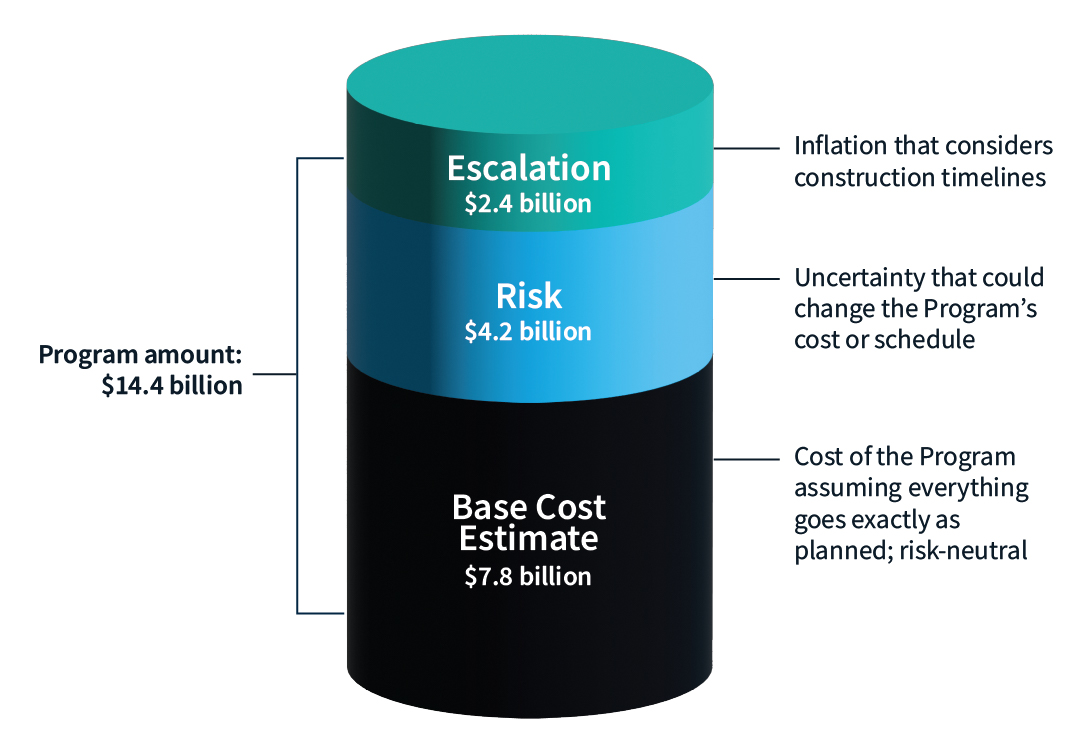
The estimated cost to build the five-mile corridor is $13.5 billion to $15.2 billion with a likely cost of $14.4 billion. The updated cost estimate reflects national trends of significant cost increases driven by inflation and market conditions leading to higher construction bids.
The estimate represents a 45% to 85% probability that costs will fall within that range. For financial planning, the Program will use $14.4 billion, as there is a 70% chance the cost is that number or lower.
- Base cost: $7.8 billion (54%)
- Inflation and risk: $6.6 billion (45%)
- Risks are details not yet known or that could change, such as: schedule delay, market conditions, materials costs, tariffs and workforce trends, design changes, and permitting.
- Inflation that considers construction timelines.
With approximately $5.7 billion in committed funding, the Program is advancing a core set of projects that ensure we can move forward with building a safer replacement bridge as a first step.
What does the Cost Estimate include?
The Modified Locally Preferred Alternative (LPA) provides a basis for the 2026 cost estimate. The cost estimate was developed for the full 5-mile program and includes:
- Replacement bridges over the Columbia River and replacement of the North Portland Harbor Bridge
- Three through lanes and one auxiliary lane southbound and northbound
- Extension of light rail from Portland to Vancouver, with the addition of three new station locations
- Rebuilt interchanges at Marine Drive, Hayden Island, SR 14, Mill Plain Boulevard, Fourth Plain Boulevard and SR 500
- A bridge for local traffic connecting Hayden Island to Marine Drive
- Improvements for people who walk, bike and roll
For more information, visit the Modified LPA page.
Why did costs increase from 2022?
Risk impacts
Over 400 risks identified for the Program — the top risks include uncertainty around schedule delays and market conditions such as competition and pricing.
Increased probability costs
The 2022 estimate used probability cost in the 60th percentile. The 2026 estimate uses a 70th percentile probability cost in alignment with Federal Highway Administration requirements.
Schedule extension impacts
Program completion was extended from 2034 to 2045 following a two-year delay in the federal environmental process and based on updated construction sequencing requirements. This extended timeline impacts:
- Escalation of overall cost to complete for engineering and construction.
- Additional years of management and delivery costs.
Escalation impacts
Construction costs increased 58% based on escalating materials, labor and equipment prices since 2022, consistent with industry trends.
WSDOT inflation forecasts were replaced with an IBR-specific inflation forecast, resulting in a higher Year-of-Expenditure (YOE) Program estimates.
Scope and quantity updates increased base cost
The 2022 estimate was based largely on quantities derived from the previous Columbia River Crossing Program. The 2026 estimate used detailed quantities based on updated conceptual design plans and constructability reviews.
A Core Set of Projects to Advance Construction
The Program will be delivered in phases as funding is secured, allowing the full five-mile corridor to be built over time. The Program is advancing a core set of projects as the foundation for completing the broader Program. This includes replacing the bridge over the Columbia River, connecting the new bridge to I-5, extending light rail to the Vancouver waterfront, pre-completion tolling and removing the existing bridges.
Cost Estimate for Core Set of Projects
The Program's core set of projects is estimated at $7.09 billion (Year of Expenditure, 70th percentile), reflecting a delivery approach that consolidates contracts to reduce risk and oversight costs, along with a refined approach to pre-completion tolling work.
What Are We Building First?
With approximately $5.7 billion in committed funding, the Program can continue moving forward toward construction of the replacement bridge and connections to I-5 while the remaining funding is secured to complete construction of the core set of projects, including pursuing funding for light rail. The first funded phase that will be built with the committed funding includes:
- Building the replacement bridge with a shared-use path, width for future light rail construction, three through lanes and one auxiliary lane in each direction and safety shoulders
- Connecting I-5 to the bridge in Oregon and Washington
- Connecting SR 14 and Hayden Island to I-5
- Constructing tolling infrastructure
- Advancing design of the light rail extension to the Vancouver Waterfront for future construction
- Removing the existing bridge
Learn more about the IBR Program’s plan for a first phase of construction.
Closing the Funding Gap
The Program continues to evaluate opportunities for cost savings, including design refinements, value engineering (identifying lower cost approaches without compromising function), risk management, as well as potential contracting and scheduling efficiencies. Work is also ongoing to pursue $1 billion from the FTA Capital Investment Grant program. Other future opportunities could include federal grant options such as INFRA and BUILD, and working with both states to consider other cost savings, funding, and financing opportunities.
The Program will continue to coordinate with partners as the Program works to refine construction sequencing and funding strategies. Future phases of work for the five-mile corridor will be sequenced to align with available funding.
Committed & Proposed Funding
The IBR Program has approximately $5.7 billion in committed funding.
| Funding Source | Total Amount |
| Mega (USDOT National Infrastructure Project Assistance Program) Grant | $600 M |
| BIP (FHWA Bridge Investment Program) Large Bridge Grant | $1,500 M |
| Move Ahead Washington - Federal Formula Funding | $650 M |
| Move Ahead Washington - State Funding | $350 M |
| Oregon HB 5005 - State Funding | $1,000 M |
| Previous State Fundingº | $90 M |
| Projected Toll Funding Amount¹ | $1,500 M |
| Committed Funding Available for a Funded Phase | $5,690 M |
| CIG (FTA Capital Investment Grant Program) Full Funding Grant Agreement² | $1,000 M |
| Committed and Prospective Funding Available for a Funded Phase | $6,690 M |
| Connecting Washington Funding³ | $118 M |
| USDOT Reconnecting Communities Pilot (RCP) Program* | $30 M |
| Committed and Prospective Funding Available for the entire IBR Program | $6,838 M |
Footnotes:
Note: Funding amounts include historical expenditures.
º Updated amount to align with actual programmed amounts
¹ Reflects updated 2026 toll funding analysis conducted by WA State Treasurer and ODOT. Previous placeholder amount was $1.25B.
² This competitive grant funding requires a light rail transit investment and will require local funds for match.
³ This Washington State funding is currently budgeted for the Mill Plain / I-5 interchange only.
*This announced award of grant funding requires investment in the Evergreen Boulevard Community Connector Lid over I-5.
For More Information
- 2026 Initial Financial Plan
- Cost Estimate Validation Process (CEVP) Report
- Cost Estimate Validation Process (CEVP) Report Addendum*
*The IBR Program re-ran a cost and schedule risk analysis in early 2026 focused specifically on the core set of projects and first funded phase. This addendum builds on the previous year's analysis of the full IBR Program.
How many jobs will be supported by the construction of IBR Program Investments?
The billions of dollars invested in the construction of the replacement bridge will support thousands of jobs. Earnings generated by jobs will infuse money into our local economy in the form of rent payments, utilities, and all the other ways that salaries and earnings flow through our community.
The Program is attracting federal dollars to the region that would be spent elsewhere if not for this project. The billions of dollars invested in the IBR Program will positively impact our local economy through jobs and spending. This includes:
-
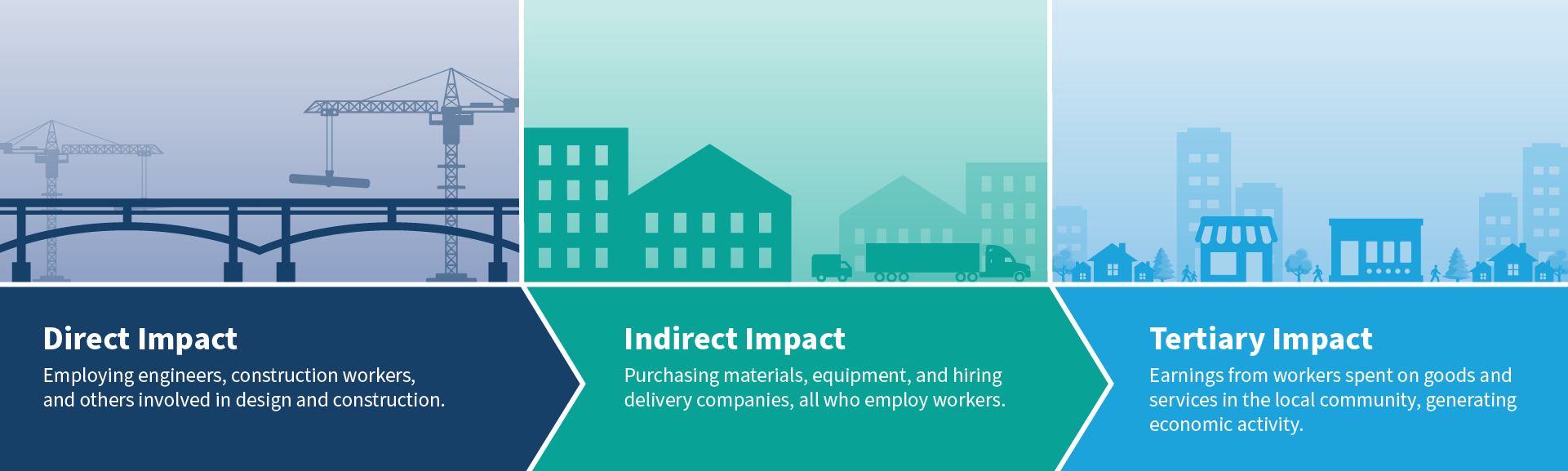
Direct Impacts: Construction of a replacement bridge will generate tens of thousands of jobs across many industries, such as engineers and construction workers, as well as suppliers of materials.
-
Indirect Impacts: Indirect jobs are those that exist to produce the goods and services needed for the work being completed by those with direct jobs.
-
Tertiary Impacts: The economic impact multiplies when a job at a construction site then supports jobs in local restaurants, retail stores, and other places workers spend their wages.
How will Tolling Details be Determined?
Tolling for the IBR program is anticipated to include variable priced tolling with the goal of funding construction and facility operations and maintenance. Tolling will also improve reliability when travelers skip optional trips, choose other routes, modes of travel and time of travel.
Toll rates and policies for the IBR Program will be jointly set by the Oregon and Washington Transportation Commissions to support the toll funding amount identified in the program’s financial plan. In early 2024, both commissions stood up an I-5 bridge bi-state tolling subcommittee. The subcommittee is made up of two commissioners from each state and will jointly recommend toll rates and policies, including potential discounts, to each state’s respective full Commissions.
Also, in late 2024, the Oregon and Washington Transportation Commissions approved four toll rate scenarios to be studied in the next round of tolling analysis (referred to as a level 3 ‘investment grade’ toll traffic and revenue analysis) to confirm we can meet funding targets:
- Toll rates ranging from $1.55 to $4.70 per trip
- Truck toll rate multipliers ranging from 1.5x to 4x
- Low-income toll program with a 50% discount for registered individuals at or below the 200% federal poverty level
These scenarios do not identify final toll rates or policies but moves them forward for additional analysis. The commissions are anticipated to adopt toll rates about 8 months before tolling is estimated to begin on the facility. The earliest tolling is currently anticipated to start on the Interstate Bridge is in 2028.
To submit written public comment, please email info@bistatesubcommittee.org
You can learn more about the bi-state toll subcommittee, find meeting materials and view videos of past meetings on each commission’s website.
Oregon Transportation Commission toll subcommittee
Washington State Transportation Commission toll subcommittee
Sign up to receive updates on the bi-state subcommittee
Thank you for subscribing.